Web Development Frameworks

Co-Founder
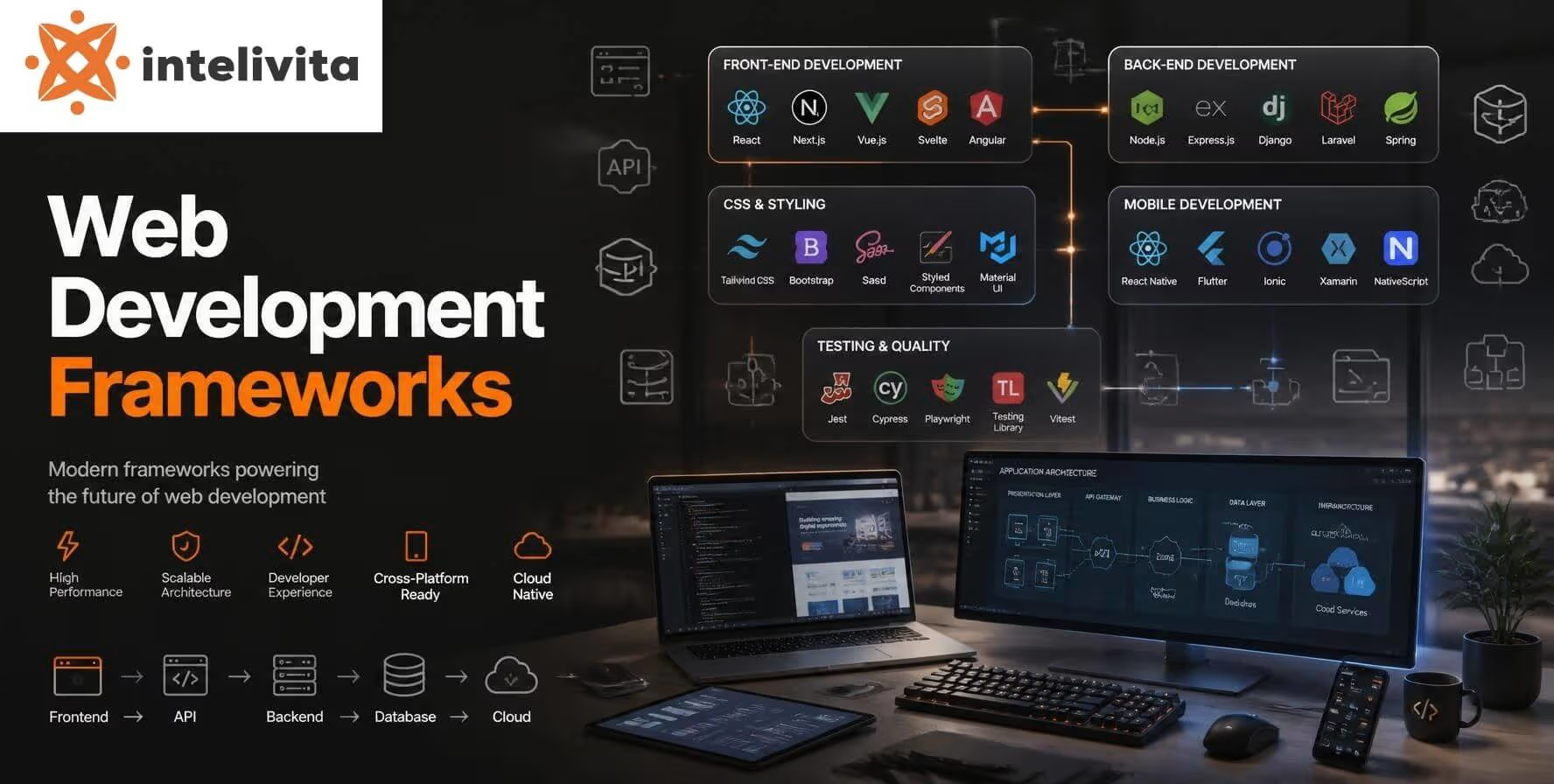
A web development framework is a set of pre-written code that developers use to build websites and apps without starting from scratch. A framework for web development handles routing, database connections, and authentication, letting UK development teams focus on business logic.
The framework supports efficiency through reusable components, scalability through modular architecture, security through built-in protections against vulnerabilities, and maintainability through consistent coding patterns that a web application framework applies in a codebase, a standard many London-based agencies rely on for client projects.
The best frameworks for web development are listed below.
- Django: Provides built-in ORM, authentication, and admin panels for data-heavy applications.
- Laravel: Offers clean syntax, built-in queuing, and Eloquent ORM for scalable server-side logic.
- React: Lets developers build interfaces through reusable components and a virtual DOM.
- Ruby on Rails: Follows convention over configuration and lets developers scaffold apps with minimal setup.
- Express.js: Handles routing and middleware for fast, minimalist back-end services.
- Spring Boot: Simplifies microservices architecture with embedded servers and auto-configuration.
What is a Framework in Web Development?
A framework in web development is a pre-structured collection of libraries, tools, and conventions that developers use to build applications faster, without writing repetitive boilerplate code. Framework centres on Model-View-Controller (MVC), so teams follow consistent coding patterns in routing, data handling, and templating.
Frameworks provide structure by dictating folder hierarchies, built-in modules for authentication, ORM integration, and middleware, which simplifies collaboration and reduces technical debt.
How does a Web Development Framework Work?
A web development framework works into components like models, views, and controllers, ensuring each layer handles a responsibility within the request-response cycle. It organises workflows via routing systems that map URLs to specific controller actions, with middleware pipelines that intercept requests for tasks (authentication, validation, and logging) before reaching the application logic.
Common tools include built-in ORMs for database abstraction, templating engines for HTML rendering, dependency injection containers for managing object lifecycles, and CLI scaffolding utilities that generate boilerplate code for models, migrations, and routes.
Why are Web Development Frameworks Important?
Web development frameworks are important because they implement consistency, reducing technical debt and easing maintenance in large, collaborative codebases.
Frameworks strengthen security posture via built-in protections against common vulnerabilities like SQL injection and cross-site scripting (XSS), safeguarding applications without requiring developers to implement the wall manually.
What are the Benefits of Using Web Development Frameworks?
The benefits of using web development frameworks are listed below.
- DRY Principle Enforcement: Developers leverage pre-built modules and libraries in multiple projects.
- MVC Pattern Adoption: Frameworks implement design patterns like Model-View-Controller, simplifying collaboration among distributed development teams.
- CSRF and XSS Mitigation: Frameworks provide native protections against SQL injection, cross-site scripting, and cross-site request forgery vulnerabilities.
- Microservices Compatibility: Modular components and microservices integration allow applications to handle increased traffic without major refactoring.
- Structured Handling: Built-in error-handling mechanisms and logging tools help developers isolate issues more quickly than unstructured codebases.
- Open-Source Ecosystem Access: Popular frameworks maintain active developer communities, offering plugins, documentation, and troubleshooting resources readily.
- Reduced Overhead Costs: Reduced development hours and lower maintenance overhead translate into decreased project costs for clients.
How do Frameworks Improve Developer Productivity?
Frameworks improve developer productivity through tools that auto-generate boilerplate code for models, controllers, and routes, eliminating repetitive manual setup. Frameworks simplify workflows via built-in CLI commands for tasks (database migrations, testing, and deployment), reducing context-switching between tools.
Reusable components and standardised libraries let developers focus on business logic instead of rebuilding common functionalities from scratch.
How to Choose the Best Framework for Web Development?
To choose the best framework for web development, follow the seven steps listed below.
- Assess Project Scope. Evaluate the application's complexity, expected traffic volume, and required feature set before shortlisting candidate frameworks.
- Evaluate Language Compatibility. Match the framework to the programming language the development team already knows (Python, JavaScript, or PHP).
- Check Scalability Support. Confirm the framework handles horizontal scaling and microservices integration for future growth.
- Review Community Ecosystem. Examine the availability of plugins, third-party libraries, and active forums for troubleshooting support.
- Analyse Performance Benchmarks. Compare rendering speed, server response times, and resource consumption in competing frameworks.
- Verify Security Features. Confirm that built-in protections against SQL injection, cross-site scripting, and cross-site request forgery vulnerabilities exist.
- Test Documentation Quality. Review the official documentation for clarity and up-to-date code examples before committing.
Which Framework is Best for Small Business Websites?
The frameworks that are best for small business websites are Bootstrap and Tailwind CSS, offering pre-built UI components that speed up front-end development without heavy custom coding.
Laravel suits businesses needing custom backend functionality, providing routing, built-in authentication, and a manageable learning curve for small development teams. Vue.js works well for interactive single-page interfaces, delivering lightweight performance without the curve of larger frameworks.
Do Web Development Companies Use Custom or Open-Source Frameworks?
Web development companies use open-source frameworks (Laravel, Django, and React). Open-source offer faster deployment through pre-built libraries, active community support, and proven security patches. Custom frameworks get built only when a project demands architecture, proprietary performance optimisation, or strict compliance requirements that off-the-shelf solutions do not satisfy.
Factors influencing the choice include project budget, timeline, requirements, and the development team's existing technical expertise. Startups evaluating the options consult a web development company to determine if open-source flexibility or custom-built control better serves their long-term technical roadmap.
What Features do Web Development Frameworks Provide?
The features that web development frameworks provide are listed below.
- Routing Mechanisms: Frameworks map incoming URLs to controller actions, directing traffic through defined application pathways.
- ORM Integration: Object-Relational Mapping tools translate database records into usable code objects, simplifying data manipulation tasks.
- Templating Engines: Built-in rendering systems generate dynamic HTML output by merging server-side data with reusable page layouts.
- Middleware Pipelines: Request-interception layers handle authentication, logging, and validation before reaching core application logic.
- CLI Scaffolding Tools: Command-line utilities auto-generate boilerplate code for models, migrations, and route definitions.
- Dependency Injection Containers: Object lifecycle managers handle class instantiation, reducing tight coupling between application components.
- Built-In Testing Suites: Integrated unit-testing modules let developers verify code functionality without external tool installation.
How do Frameworks Support Reusable Code?
Frameworks support reusable code through inheritance, mixins, and modular components, letting developers call the same logic in multiple files instead of writing it again. A base class stores shared methods and extends that base, only adding or changing the parts that differ from module to module.
Sample:
| classBaseController { index() { returnthis.model.findAll(); }}classUserControllerextendsBaseController { constructor() { super(); this.model = UserModel; }} |
UserController reuses index() from BaseController, so the fetch logic exists once and works for any model plugged into it.
What is Built-In Routing in Web Frameworks?
Built-in routing in web frameworks is a system that maps incoming URLs to specific controller actions or handler functions, directing each request to the correct piece of application logic. It reads the HTTP method and path from an incoming request, then matches it against a predefined set of route definitions stored within the framework's configuration.
The router passes the request to the assigned controller, once matched, which processes the data and returns the appropriate response to the client.
How do Frameworks Handle Database Integration?
Frameworks handle database integration by providing an ORM layer, which turns database tables into code objects so developers query data using method calls instead of raw SQL.
Frameworks let teams switch database engines without rewriting queries, while migrations track schema changes as version-controlled files to keep every environment in sync. Connection pooling reuses a fixed set of open connections instead of opening a new one per request, keeping the application responsive under heavy traffic.
Why are Security Features Important in Web Frameworks?
The security features important in web frameworks are listed below.
- SQL Injection Prevention: Parameterised queries and ORM abstraction stop attackers from manipulating database commands through unsanitised input fields.
- Cross-Site Scripting Mitigation: Built-in output encoding strips malicious scripts from user-submitted content before rendering it on a page.
- CSRF Token Validation: Frameworks attach unique tokens to forms, blocking unauthorised requests submitted from external malicious sites.
- Session Management Controls: Secure cookie handling and session expiration limit the window attackers have to hijack a logged-in user's session.
- Data Encryption Support: Built-in hashing libraries protect sensitive data like passwords, storing them as irreversible values instead of plain text.
What are the Different Types of Web Development Frameworks?
The different types of web development frameworks are listed below.
- Front-End Frameworks: Libraries like React, Vue, and Angular handle client-side rendering, building interactive user interfaces inside the browser.
- Back-End Frameworks: Tools like Laravel, Django, and Express manage server-side logic, routing, and database operations behind an application.
- Full-Stack Frameworks: Frameworks like Ruby on Rails and Next.js combine front-end and back-end capabilities within a single unified codebase.
- CSS Frameworks: Bootstrap and Tailwind CSS provide pre-built styling components, speeding up responsive layout design without custom stylesheets.
- Mobile Development Frameworks: React Native and Flutter let developers write cross-platform mobile applications using one shared codebase.
- Testing Frameworks: Jest and Mocha automate unit and integration testing, catching bugs before code reaches production environments.
- Microservices Frameworks: Spring Boot and Micronaut structure applications into independent, deployable services that communicate over lightweight protocols.
What is a Full-Stack Web Development Framework?
A full-stack web development framework is a toolkit that handles client-side and server-side development within one unified codebase. Next.js, for instance, manages front-end rendering through React components while handling back-end API routes and server-side logic in the same project structure. It eliminates the need to maintain separate front-end and back-end repositories for a single application.
How do Front-End and Back-End Frameworks Differ?
Front-end and back-end frameworks differ in the layer of the application they control and the environment they run in. Front-end frameworks like React and Vue run in the browser, handling user interface rendering, state management, and client-side interactivity. Back-end frameworks like Django and Laravel run on the server, managing database operations, authentication, and business logic before sending a response to the browser.
What are the Most Popular Front-End Frameworks?
The most popular front-end frameworks are listed below.
- React: Meta maintains this library, letting developers build interfaces through reusable components and a virtual DOM for faster rendering.
- Vue: The framework offers a gentle learning curve, using clear documentation and a flexible syntax accessible to newer developers.
- Angular: Google backs this framework, providing a complete toolset with built-in dependency injection and two-way data binding.
- Svelte: The compiler-based framework shifts work to build time, producing smaller bundle sizes and faster runtime performance.
- Next.js: The framework adds server-side rendering and static site generation for improved SEO performance.
- Nuxt.js: The framework handles server-side rendering and automatic routing for Vue-based applications.
- Preact: This lightweight alternative to React delivers the same component model with a smaller footprint for performance-sensitive projects, making it an entry point for teams exploring front-end web development.
How do Back-End Frameworks Support Web Applications?
Back-end frameworks support web applications through session management and caching layers, keeping user states persistent while reducing repeated database calls for frequently accessed data.
Back-end handles background job processing, offloading tasks (sending emails or generating reports) to queued workers instead of blocking the main request cycle. Frameworks like Laravel and Django standardise error logging and monitoring, giving teams visibility into app health as part of backend web development.
Which Frameworks are Used for Web Applications?
The frameworks used for web applications are listed below.
- Django: The Python framework provides built-in ORM, authentication, and admin panels for data-heavy applications.
- Laravel: The PHP framework offers clean syntax, built-in queuing, and Eloquent ORM for scalable server-side logic.
- Ruby on Rails: The framework follows convention over configuration, letting developers scaffold apps with minimal setup.
- Express.js: The lightweight Node.js framework handles routing and middleware for fast, minimalist back-end services.
- ASP.NET Core: Microsoft's framework supports cross-platform deployment and strong typing for enterprise applications.
- Spring Boot: The Java framework simplifies microservices architecture with embedded servers and auto-configuration.
- Angular: The front-end framework provides two-way data binding for building the client-side portion of a web app.
Can a Project Use Multiple Frameworks Together?
Yes, a project can use multiple frameworks together (pairing React for the front end with Django or Laravel for the back end). Each handles a distinct layer of the application. Teams combine a CSS framework like Tailwind with a JavaScript framework like Vue, letting styling and interactivity work as separate, interchangeable layers.
How do Web Development Frameworks Affect Website Performance?
Web development frameworks affect website performance through built-in caching mechanisms and lazy loading, which reduce server load and cut initial page render times.
Bundle size, database query optimisation, and server-side rendering choices affect speed, since heavier frameworks add overhead, while lightweight ones (Svelte or Express) trade features for faster execution.
What Factors Influence Framework Performance?
The factors that influence framework performance are listed below.
- Virtual DOM Diffing: Frameworks recalculate only changed elements instead of re-rendering the entire page on every update.
- Tree Shaking Efficiency: Build tools strip unused code from the final bundle, trimming file size before deployment.
- Hydration Overhead: Server-rendered pages reattach event listeners on the client, adding processing time before interactivity works.
- Reactivity Model: Frameworks like Vue use fine-grained reactivity, updating only the specific data bindings that change.
- Code Splitting Granularity: Route-based bundles load faster initially, deferring unused code until a user navigates there.
- Garbage Collection Frequency: Memory-heavy frameworks trigger cleanup cycles more often, pausing execution in high-traffic periods.
How do Web Design Frameworks Improve Website Development?
Web design frameworks improve website development through pre-built grid systems and component libraries. Adoption backs the shift toward reusable systems, with 78% of developers now using Tailwind CSS, while Bootstrap holds steady at 61% usage. It reflects how teams lean on web design frameworks for faster, standardised builds.
Which Web Design Framework is Best for Responsive Design?
The web design framework that is best for responsive design is Tailwind CSS. CSS utility classes apply breakpoint prefixes in HTML, adjusting layout at every screen size without separate media queries.
Bootstrap remains a solid alternative through its 12-column grid and pre-built responsive components, suiting teams needing a mobile-first layout fast. Criteria include breakpoint flexibility and load speed impact, central to responsive web development.
Never Miss an Update From Us!
Sign up now and get notified when we publish a new article!


 India
India
514, Silver Radiance 2, Science City Rd, Nr. Shakti Arcade, Sola, Ahmedabad, Gujarat